Individual results may vary.
Almost every consultation about hooded or heavy upper eyes comes down to a single question, and it is not the one most patients arrive asking.
Excess upper eyelid skin and a descended brow produce a very similar appearance. The eye looks hooded, the lid seems to disappear, and the face reads as tired regardless of how much sleep is behind it. The two causes are different problems, they are corrected by different operations, and treating the wrong one produces a disappointing result even when the surgery itself is well executed.
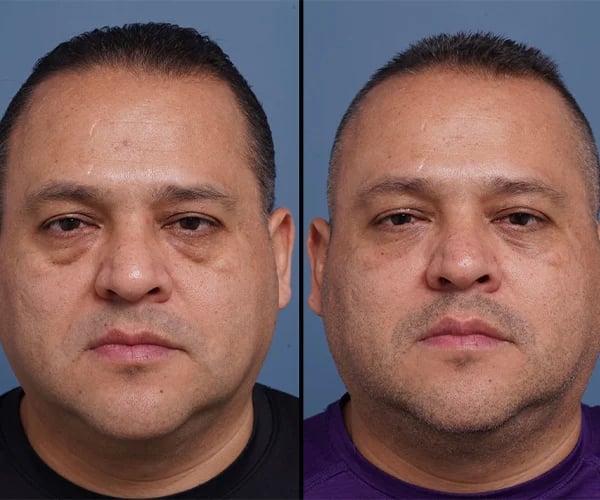
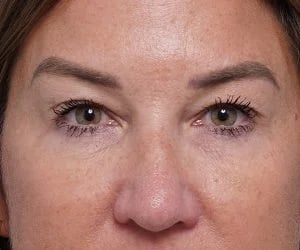
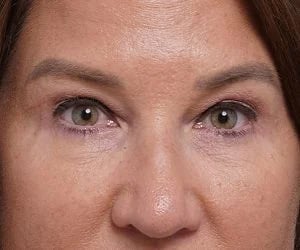
The reason this matters for a gallery is that it tells you where to look. When comparing a before and after pair here, check the position of the eyebrow in each image first.
If the brow sits in the same place in both photographs and the lid shows more than it did, the change came from the eyelid. If the brow has moved upward, the brow was addressed, either alone or alongside the lid.
The assessment is simpler than patients expect.
Gently lifting the brow to where it naturally sat in earlier years shows how much of the apparent excess disappears. What remains is lid skin. What vanishes was brow.
Why this matters in practice: when the brow has descended, the skin gathering at the eyelid has effectively arrived from the forehead. Removing it at the lid removes skin that belongs higher up, which can pull the brow further down and leave a hollow or surprised appearance that still reads as tired. Conversely, lifting a brow when the real problem is genuinely excess lid skin leaves the hood in place and raises the forehead around it.
The practice covers blepharoplasty and brow lift separately for this reason, and the article on fixing sagging eyelids works through the same distinction in more detail.
Upper lid. Look at how much of the lid platform is visible between the lash line and the crease. That visible strip is what patients are usually describing when they say their eyes look smaller or that makeup has nowhere to go.
Lower lid. Look at the transition between the lower lid and the cheek. A step or shadow there is produced by fat sitting forward of the bone combined with hollowing below it, and the bulge and the hollow are two halves of the same change rather than separate problems.
Symmetry. Most faces are mildly asymmetric before surgery and remain so afterward, since surgery improves rather than erases that. A pair of photographs showing perfect symmetry afterward is unusual rather than typical.
Expression. Eyes photograph very differently depending on whether the patient is relaxed, raising the brows slightly, or beginning to smile. Raising the brows masks hooding, so a before photograph taken with the brows raised understates the problem and an after photograph taken that way overstates the result.
Eyelid surgery swelling settles over weeks to months, and the incisions, which are placed in the natural crease of the upper lid or just beneath the lower lash line, fade over a considerably longer period.
An early photograph therefore shows a result that is not yet settled and scars that are more visible than they will be. A photograph taken once healing is complete shows something different. This is worth knowing when comparing galleries between practices, since one may show early results and another mature ones with both being honest.
Not every tired-looking eye is corrected by eyelid or brow surgery.
Where the concern is hollowing rather than excess skin, adding volume may serve better, and facial fat grafting addresses that directly. Where the whole upper face has descended rather than the brow alone, a deep plane facelift or facelift considers the face as a unit. Where the concern is fine lines rather than structure, non-surgical options including neuromodulators, dermal fillers and non-surgical rejuvenation may be more appropriate.
A consultation that concludes a different procedure suits you better is a useful consultation.
In some patients upper eyelid skin descends far enough to rest on the lashes and intrude on the upper field of vision. This is a recognised presentation and is assessed clinically rather than cosmetically, and patients who find themselves tilting the head back to read or noticing the upper field obstructed should mention it specifically at consultation.
Every photograph here shows one patient's outcome and is not a prediction, a guarantee or an indication of a typical result.
Eyelid and brow outcomes depend on starting anatomy, skin quality and elasticity, brow position, bone structure around the eye socket, age and individual healing. Two patients having the same named operation can begin from very different places and reach very different outcomes, both of them good.
Photographs show results, while patient testimonials describe the experience.
Background on Dr. Justin Bellamy is on his profile page, and the about section covers the practice, including awake surgery for patients interested in procedures under local anesthesia.
The broader face gallery shows results across all facial procedures, and the full photo gallery covers every category.
The distinction between brow and lid is made by examination, not from a photograph. The practice is in Palm Beach Gardens, Florida, and appointments can be arranged through the contact page.
Look at where the eyebrow sits in each photograph. If the brow is in the same position in both and more of the lid is visible, the change came from the eyelid. If the brow has moved upward, the brow was addressed, either alone or alongside the lid. The two produce a similar appearance when hooded and are different problems with different operations.
By examination. Gently lifting the brow to where it naturally sat in earlier years shows how much of the apparent excess disappears. What remains is eyelid skin and what vanishes was brow position. This matters because removing skin at the lid when the brow is the cause can pull the brow lower and leave a hollow appearance that still reads as tired.
Because most faces are mildly asymmetric to begin with and remain so afterward. Surgery improves asymmetry rather than erasing it, and a result showing perfect symmetry is unusual rather than typical. Comparing the degree of asymmetry before and after is more informative than looking for its absence.
In some patients upper eyelid skin descends far enough to rest on the lashes and intrude on the upper field of vision. This is a recognised clinical presentation and is assessed on examination. Patients who find themselves tilting the head back to read, or noticing the upper field obstructed, should raise it specifically at consultation.
Swelling after eyelid surgery settles over weeks to months, and the incisions, placed in the natural upper lid crease or just beneath the lower lash line, fade over a considerably longer period. An early photograph shows a result that has not yet settled, with scars more visible than they will become. This is also why galleries from different practices are not always directly comparable.
Individual results may vary.


© 2026 Justin Bellamy, MD